
Garden Diary: Hollyhocks in Late July
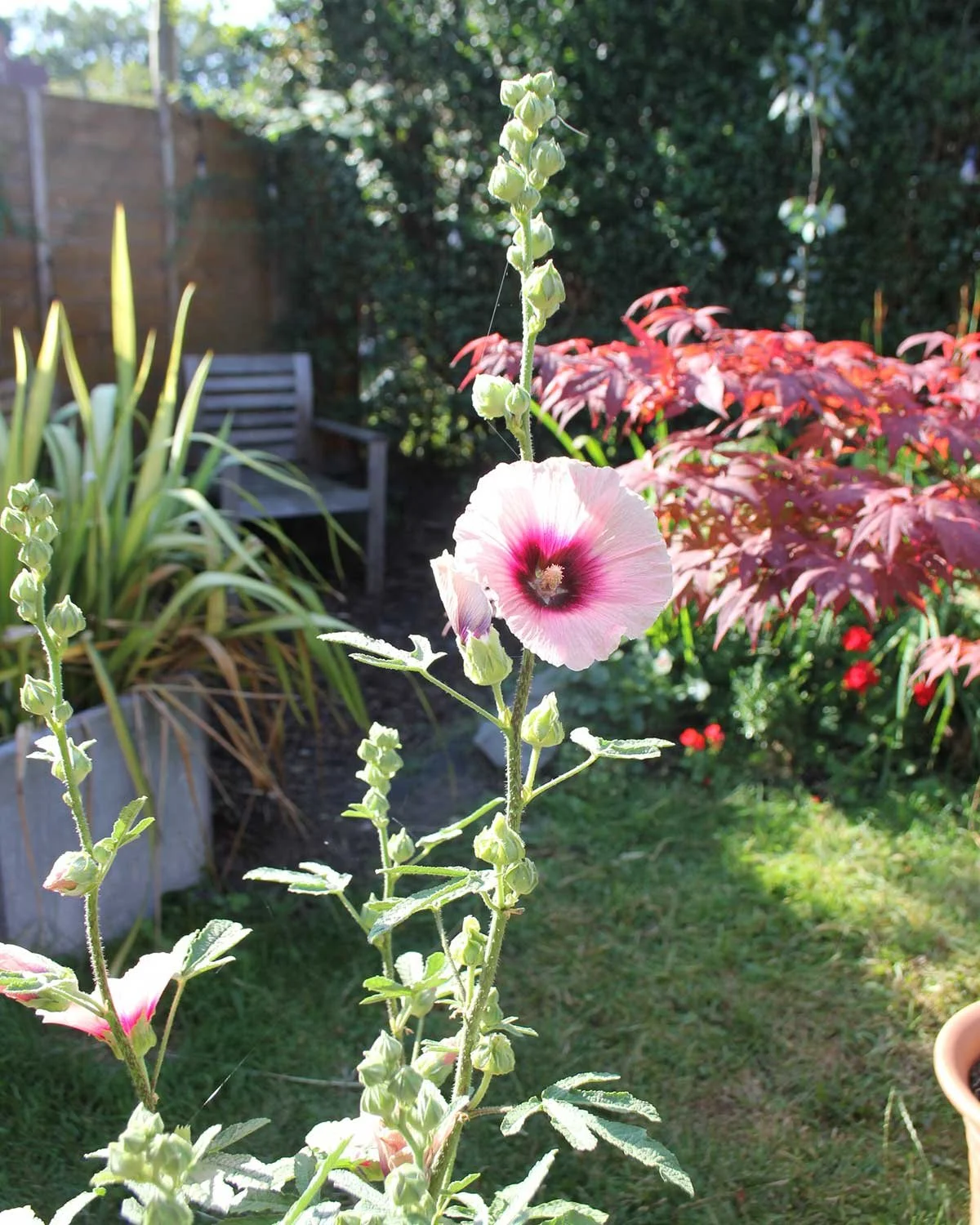
For my birthday this year my parents gave me the most beautiful Hollyhocks in a dusty antique pink. I decided to plant the Hollyhocks in a large plant pot, for now. The reason behind this decision was twofold, to protect them from the ongoing slugmaggedon and to rotate their position around the garden to establish the perfect spot before potentially planting them directly into the ground. Since planting them in a pot, I have been creating an eggshell moat around the base as a slug defence system, which thankfully seems to be working.
I have been somewhat infatuated with Hollyhocks since visiting the Histon Open Garden Day this summer. They seem to be a very popular choice for cottage style gardens and thrive in these long sunny days that we are experiencing of late.
Since my love of Hollyhocks began to bloom I have been doing a little reading up on them. Hollyhocks (Alcea species) are believed to have originated in Asia, particularly China, before spreading to the Middle East and Europe. They became popular in European gardens during the 15th and 16th centuries and were later introduced to North America by European settlers.
Throughout history, Hollyhocks have long been associated with traditional cottage gardens because of their tall flower spikes and ability to self-seed, allowing them to return year after year. Today, the most commonly grown species is Alcea rosea, which is cultivated worldwide for its ornamental value.
Hollyhocks are tall plants that typically grow between 1.5 and 2.5 metres in height, mine is nowhere near that tall yet, but is growing steadily. They produce large, cup-shaped flowers in colours including white, yellow, pink, red, purple, and almost black. The bees flock to the pollen laden flowers and butterflies can often be seen dancing around the stems, which is always a pleasure to see.
Hollyhocks have inspired many poets over the years, I particularly loved this verse by Edgar Albert Guest, an American poet who became known as the "People's Poet" for his accessible and optimistic verse.
The mother loved them years ago;
Beside the fence they used to grow,
And though the garden changed each year
And certain blooms would disappear
To give their places in the ground
To something new that mother found,
Some pretty bloom or rosebush rare—
The hollyhocks were always there.
Often described as old-fashioned, to me Hollyhocks have a timeless beauty. Most varieties are biennials, producing leaves in the first year and flowers in the second, although some are short-lived perennials. Hollyhocks grow best in full sun and well-drained soil and are known for their rough, hairy leaves and strong upright stems.
I’ve been captivated by these beautiful flowers and have been out to visit them in the morning light and in the evening as the sun is hanging low in the sky. Here's to Hollyhocks, may they grow tall and bright and bring a smile to your face year after year.